Fresh Realm Gold Guide: Your First 100 Gold on a New Vanilla Server
A fresh realm gold guide for a new vanilla-era server: what sells in week one, vendor or auction house, the level 10 and 20 skill budgets and a weekly plan to 30
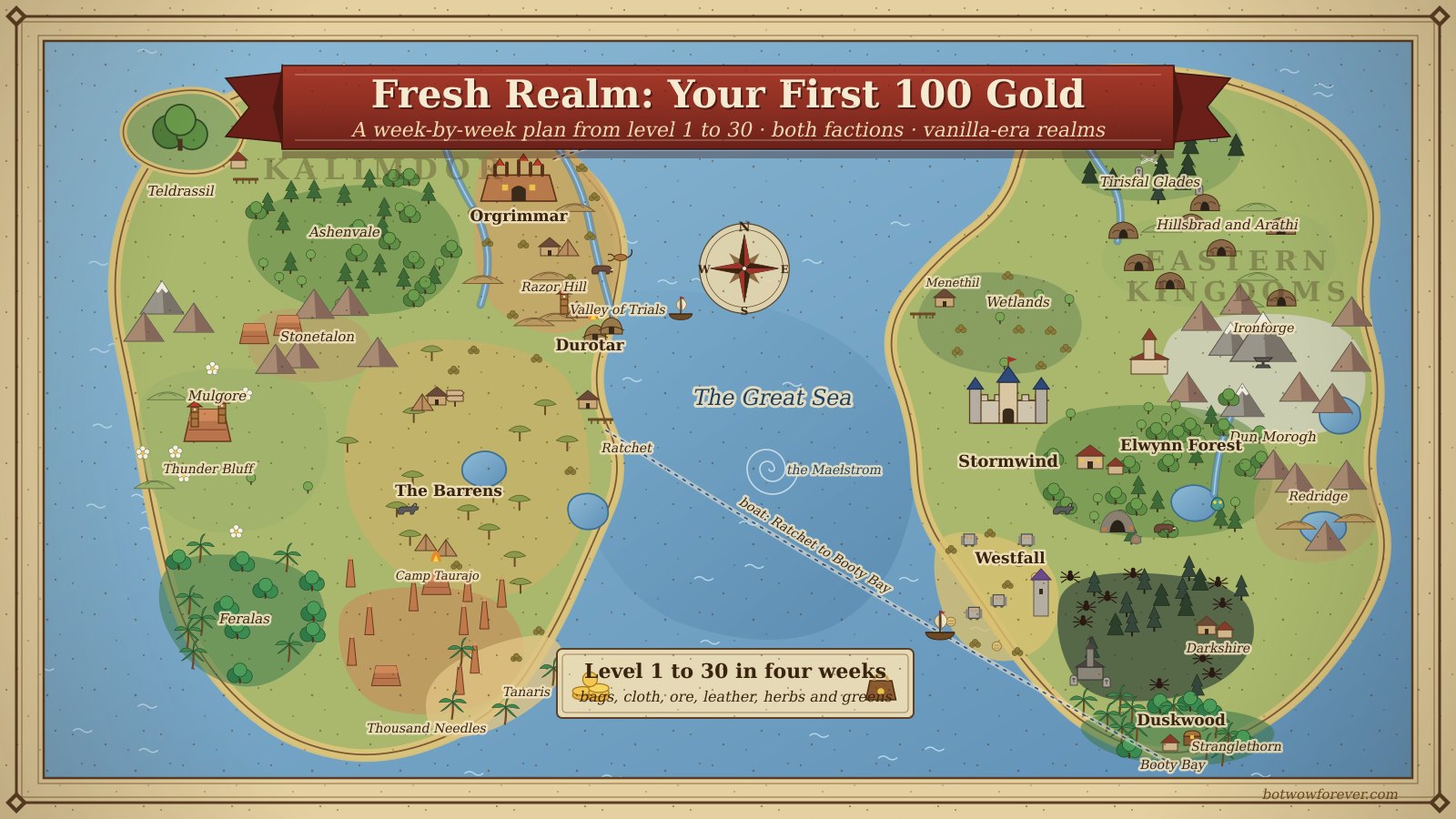
The first weeks of a new realm are the only time the economy runs upside down: nobody has gold, everybody needs bags, and a stack of Linen Cloth sells for more than it will for the rest of the server's life. The trick is to sell the right things at the right counter and to stop spending on the wrong ones. This fresh realm gold guide walks a character from level 1 to roughly 30 with 100 gold in the bank at the end: what sells in week one, when the auction house beats the vendor, what the level 10 and level 20 trainer visits really cost, and which of our zone guides to run in each bracket, for either faction on a vanilla-era realm such as WoW Forever.
Where and what you need
Levels. Nothing here needs a level you do not have; the plan starts at the first vendor in the starter valley and ends around 30, over four weeks of ordinary evenings. If you are already 20 with an empty purse, start at stop 5.
Professions. Two gathering skills from the first village: Mining and Herbalism for a cloth-wearer or any class with downtime, Skinning and Mining for anyone who kills beasts. Gathering is where most of the 100 gold comes from. Leave crafting for later; on a fresh realm a crafter buys materials from exactly the people this plan tells you to be.
Gear. Quest rewards and drops only. The one purchase that pays for itself is a weapon around 10 if the quests have not handed you one, and even that is an auction house green for under 20 silver, never a vendor white.
Bag space. The first thing the gold buys. By 10 you want four bags, by 20 four of at least eight slots. More slots mean fewer vendor walks and more full stacks, and full stacks are what the auction house pays for.
The route
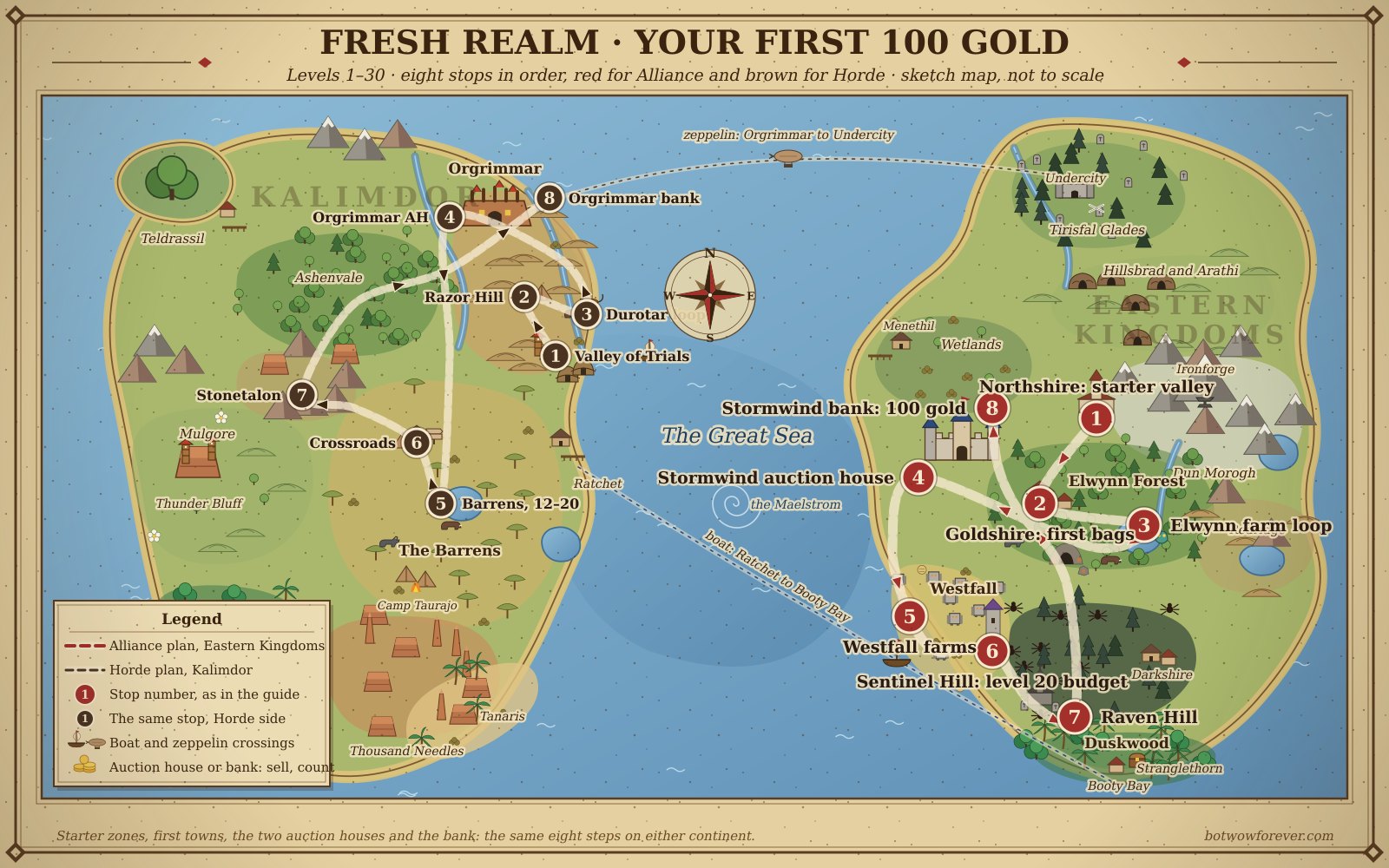
The numbers are the order of the plan rather than a walking loop; each red stop has a brown twin on the Horde continent.
- The starter valley (levels 1–6, day one). Northshire, Coldridge Valley or Shadowglen for the Alliance; the Valley of Trials, Red Cloud Mesa or Deathknell for the Horde. Loot every kill, including the one-copper teeth and feathers, and sell the lot to the first vendor. The level 4 and 6 skills cost coppers, so learn them, but buy nothing else.
- The first village (6–10, days two and three). Goldshire, Kharanos or Dolanaar; Razor Hill, Bloodhoof Village or Brill. Learn two gathering skills and start the habit the plan rests on: keep cloth, ore, leather and herbs, vendor everything else. At 10 the trainer costs roughly 50 silver to a gold for the skills you actually press, so arrive with a gold in hand. Your first extra bags come from linen: a six-slot Linen Bag costs a tailor six Linen Cloth and sells for 20–60 silver in week one.
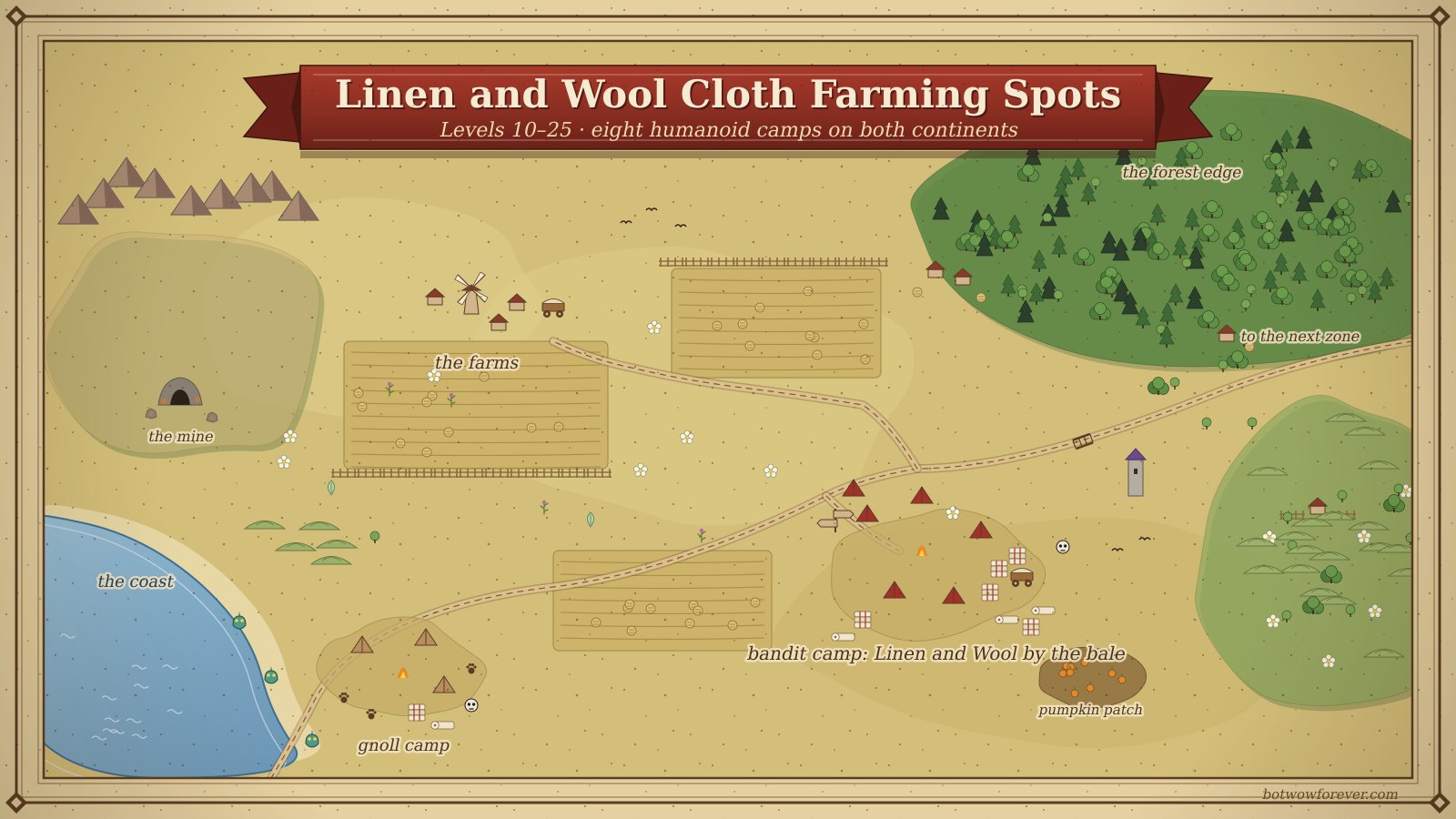
- The starter-zone farm loop (8–12, the rest of week one). Alliance characters run the Elwynn Forest gold farming route, two kobold mines of copper and linen around Goldshire. Horde characters work the boars, scorpids and quilboar of Durotar, which the Horde leveling route 1–20 covers stop by stop. Either way the loop fills the bags with Linen Cloth, Copper Ore, Light Leather, Peacebloom and Silverleaf.
- The first auction house trip (12, end of week one). Stormwind or Ironforge; Orgrimmar, Thunder Bluff or Undercity. Walk rather than fly: the flight costs as much as a bag. Post cloth, ore, leather and herbs in full stacks of 20 at the going price, bags a copper under the cheapest listing, and any green with a useful suffix. Vendor the half stacks, bank a quarter of what sells, and expect 3–6 gold from a good first trip.
- Westfall or the Barrens (12–20, week two). For the Alliance it is the Westfall farming route: Defias for linen and coin, harvest golems for vendor scrap, goretusks for leather. Horde characters run the Barrens: plainstriders, zhevra and razormane quilboar for Light Leather and the first Wool Cloth, worth more than linen while few people farm it.
- The level 20 budget (20, end of week two). Sentinel Hill or the Crossroads first, to sell and turn in quests, then the capital for the second auction house trip and the trainer. Level 20 is the first expensive visit: roughly 3–5 gold if you learn everything your class offers, roughly 2 gold if you learn only the ranks you use. Let the posted stacks sell before you buy, and leave the capital with 20 gold in the bank.
- Duskwood or Stonetalon (20–28, week three). Alliance characters take the Duskwood farming guide: Raven Hill undead for Wool Cloth and Grave Moss, worgen and spiders for silk and leather. Horde characters work the southern Barrens and Stonetalon: Venture Company goblins and harpies for wool, kodo and thunder lizards for Medium Leather. Silk Cloth begins here and is the first cloth that sells for gold a stack rather than silver.
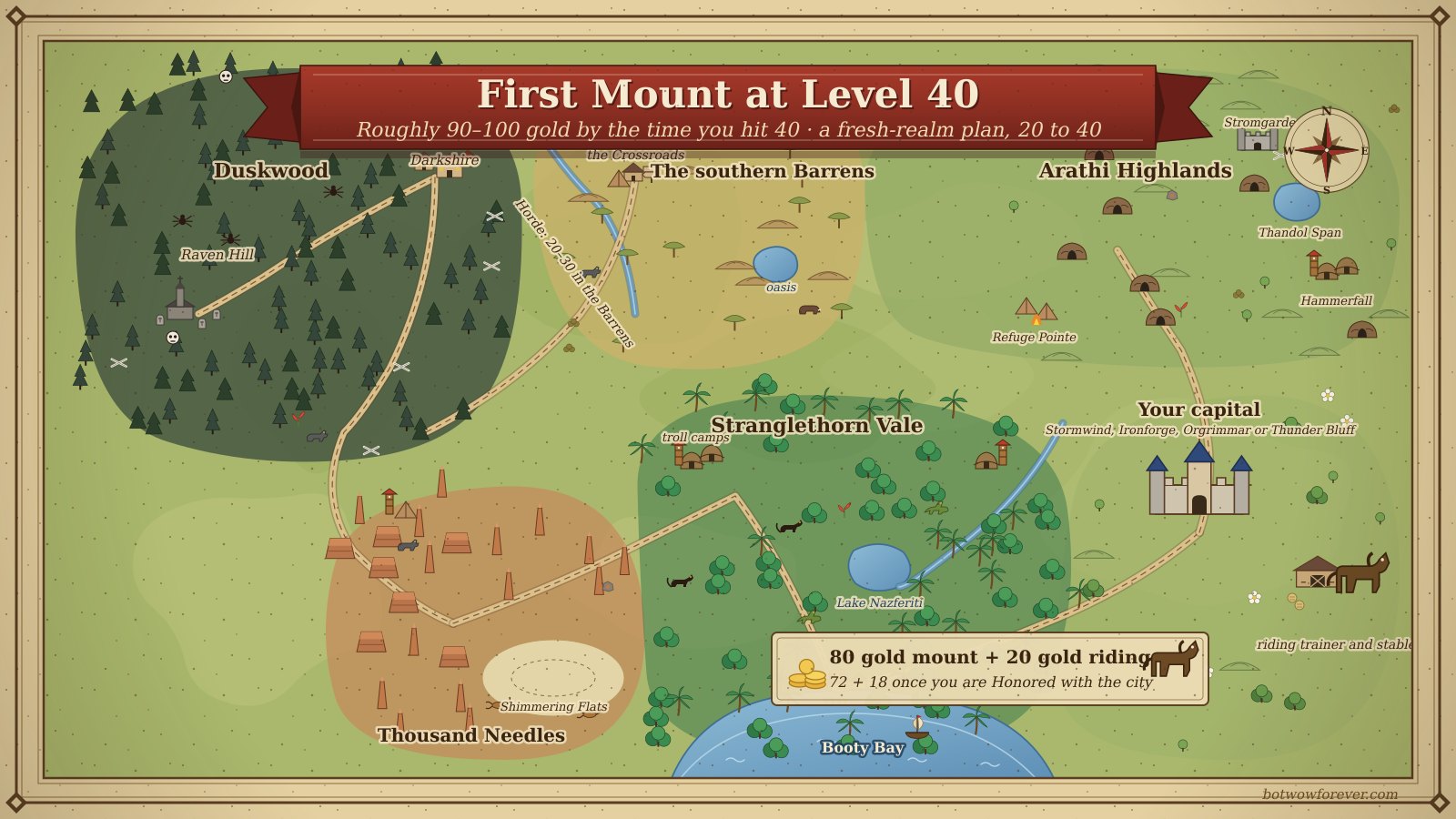
- The 100-gold check (28–30, week four). Bank everything that has sold and count. The target is 100 gold after the level 30 trainer visit, which costs roughly 5–8 gold for the skills you use. If you are short, one more week in Duskwood or the Barrens closes the gap; if you are over, you have a head start on the next plan, the first mount at level 40.
What you get
| Source | Drops and nodes | Why it sells |
|---|---|---|
| Humanoids in every zone: kobolds, Defias, quilboar, gnolls | Linen Cloth, then Wool and Silk, small bags, greens | Tailors and First Aid burn cloth by the stack in the first weeks |
| Copper and Tin veins | Copper Ore, Tin Ore, Rough and Coarse Stone, the odd gem | Blacksmiths and engineers need bars from day one, so ore sells on any realm |
| Wolves, boars, plainstriders, kodo | Light Leather, Medium Leather from 20, meat | Leatherworkers level on Light Leather and every bag recipe needs it |
| Peacebloom, Silverleaf, Earthroot, Mageroyal, Briarthorn | Herbs | Alchemists need them for the first potions and a fresh realm never has enough |
| Quests in the starter zone, first village and the 12–20 zone | Silver, cloth and leather rewards, greens, a bag or two | Quest silver is roughly a third of all your coin before 20 |
| Gray junk from every kill | Vendor coppers and silver | Small on its own, steady over four weeks |
Gold per hour
These are ranges for an ordinary character. In the starter zone and the first village, levels 1–10, you make roughly 10–40 silver an hour and most of it is vendor junk; the first gold comes from quests. On the starter-zone loop at 8–12 with two gathering skills, roughly 1–3 gold an hour. In Westfall or the Barrens at 12–20, roughly 1.5–3 gold an hour before the auction house. In Duskwood or the southern Barrens at 20–28, roughly 2–4 gold an hour.
Added up, ten evening hours a week give 10–30 gold in week one, 20–40 in week two, 25–45 in week three and the rest in week four. A hundred gold by 30 is therefore ordinary rather than heroic; the characters who miss it are the ones who spent it.
What moves the number: realm age (week one prices are roughly double week four), how many players share a mine, and whether you post full stacks or vendor half stacks.
Tips
- Sell only full stacks of 20; buyers on a fresh realm pay a premium for stacks and ignore ones and twos.
- Post in the evening and check in the morning; undercut by a copper, not by half, because the market is thin and you set the price as often as you follow it.
- Auction greens, vendor whites: a green with a suffix such as "of the Bear" fetches 20 silver to a gold even at level 10.
- Rough Stone and Coarse Stone are not junk in week one; blacksmiths need them for sharpening stones and pay 10–30 silver a stack.
- Walk until 20. Every flight before then costs the price of a bag, and the bag is the better buy.
- Carry 20 food and 20 water, not 60; stock sitting in your bags is gold that cannot work.
Running it with ForeverBot
For the questing brackets open Leveling, set From and To to the bracket you are in, keep Pick guide by level and zone, Turn in quests automatically and Equip upgrades on, and in Extra tick Sell junk, Repair at vendors and Hearthstone. Equip upgrades keeps you out of the gear vendor: quest greens go on and nothing is bought. Drop the Food/water stock slider in Settings to 20 and watch XP/hour in the Current status panel.
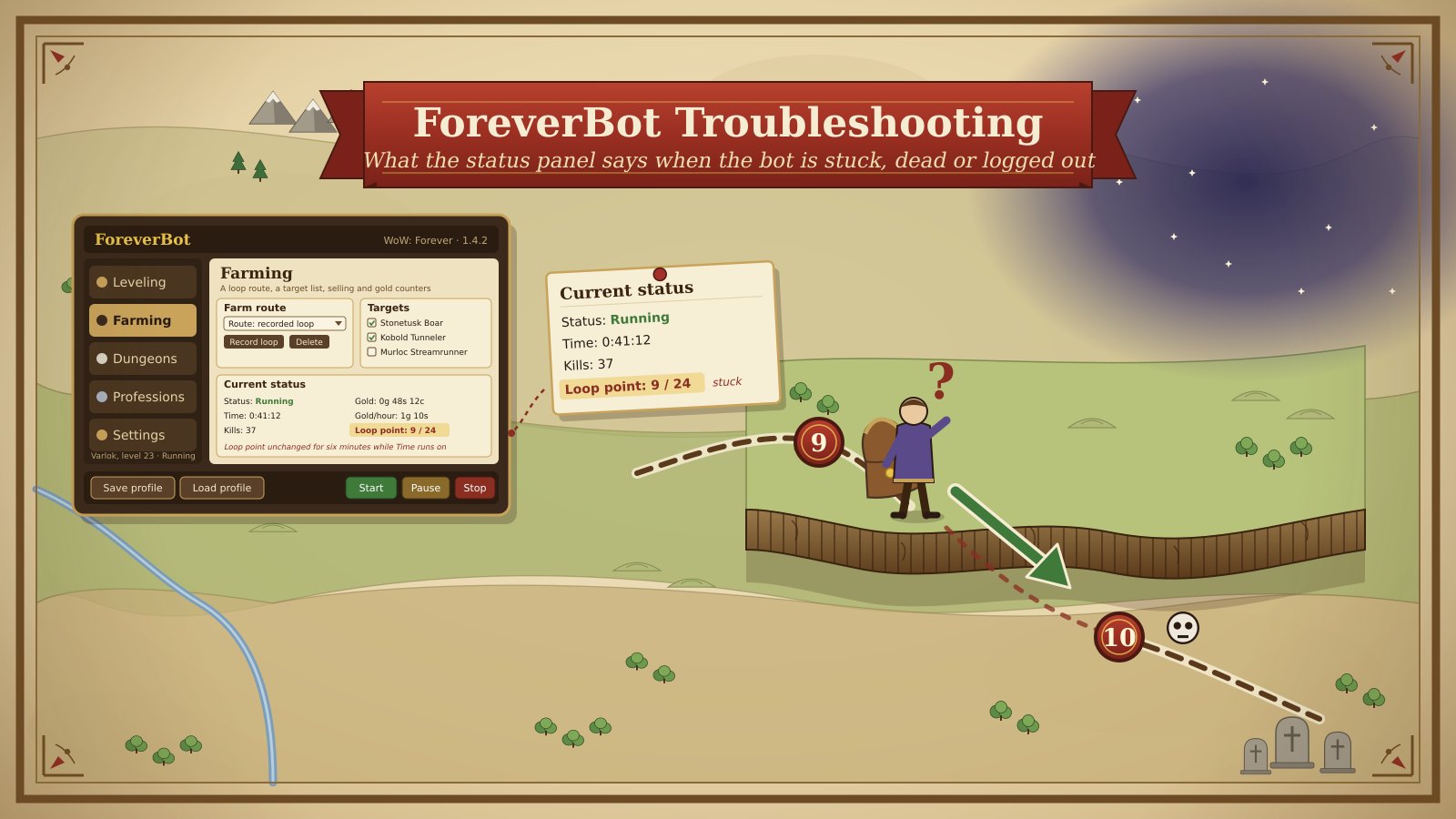
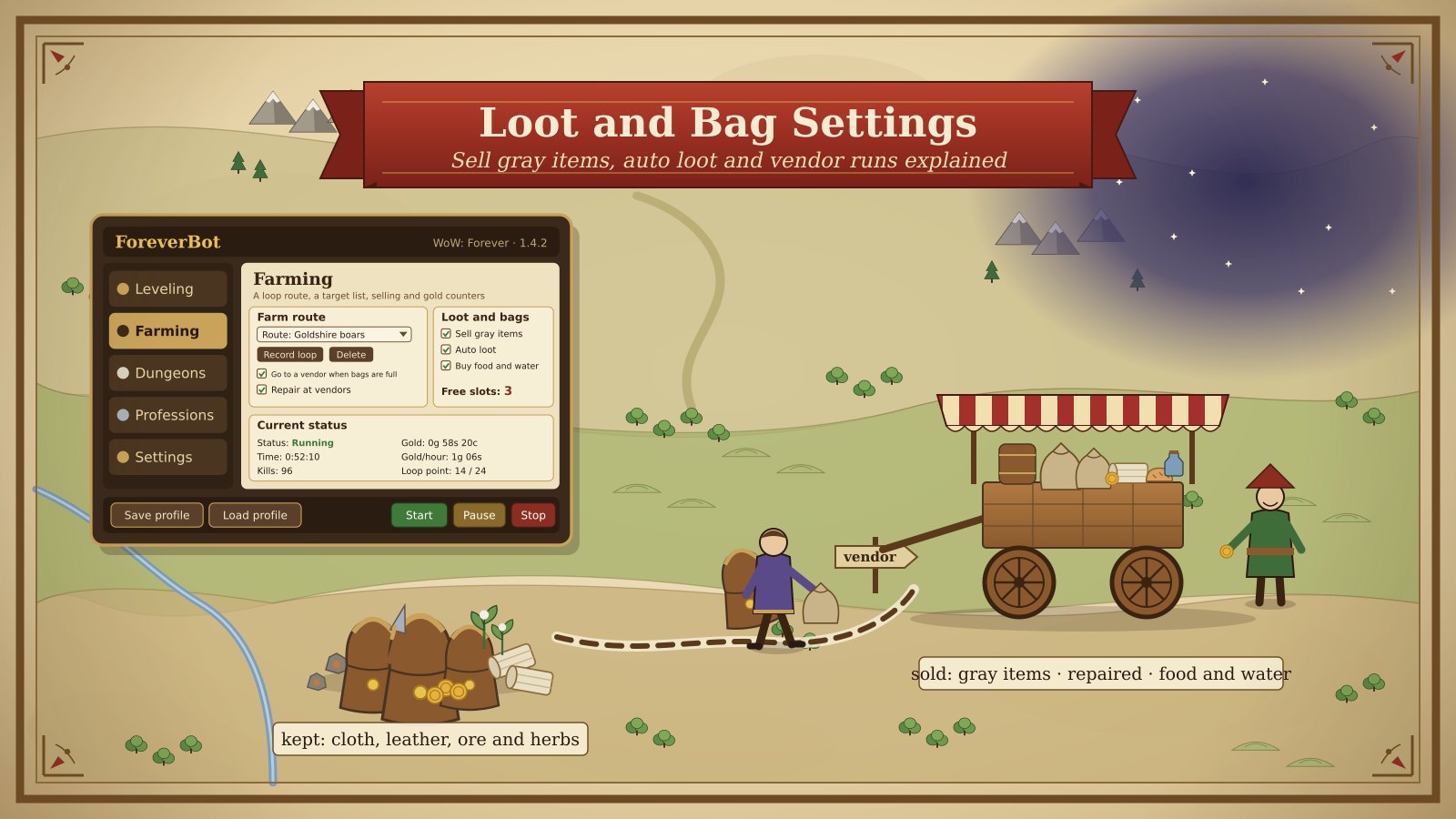
For the farm loops switch to Farming: pick a route from the Route list or walk the loop once with Record loop, build the Targets list with + Current target, and tick Sell gray items, Auto loot and Go to a vendor when bags are full. In Professions tick your two gathering skills with Remember nodes on and Skip nodes above your skill until Tin and Briarthorn are in reach. The Gold and Gold/hour counters then show which bracket is paying; save one profile per bracket with Save profile and bring it back with Load profile. All five sections are part of every plan; see plans and pricing. If this is your first evening with ForeverBot, the first-run setup guide covers the token and the window.
FAQ
Should I sell to the vendor or on the auction house on a fresh realm?
Vendor anything gray or white and any half stack; auction every full stack of cloth, ore, leather and herbs, every bag and every green with a suffix. The rule of thumb for week one is that a stack of anything a profession consumes is worth 20–60 silver on the auction house and a tenth of that at the vendor.
How much do the level 10 and level 20 skills really cost?
Roughly 50 silver to a gold at 10 and roughly 3–5 gold at 20 if you learn everything, about half that if you skip the ranks you never press. Level 30 is roughly 5–8 gold on the same terms. Learning every rank of every spell is the most common way a character arrives at 40 without a mount, which is why this fresh realm gold guide keeps saying budget.
What are the mistakes that burn the first 100 gold?
Buying gear from vendors or the auction house before 30, when quests replace it every few levels. Training every rank the trainer offers. Repairing white gear instead of replacing it, since repair bills rise with item level and a white chest piece is worth less than its own repair by 15. Flying at 12.
Want the farming done for you? Get the bot